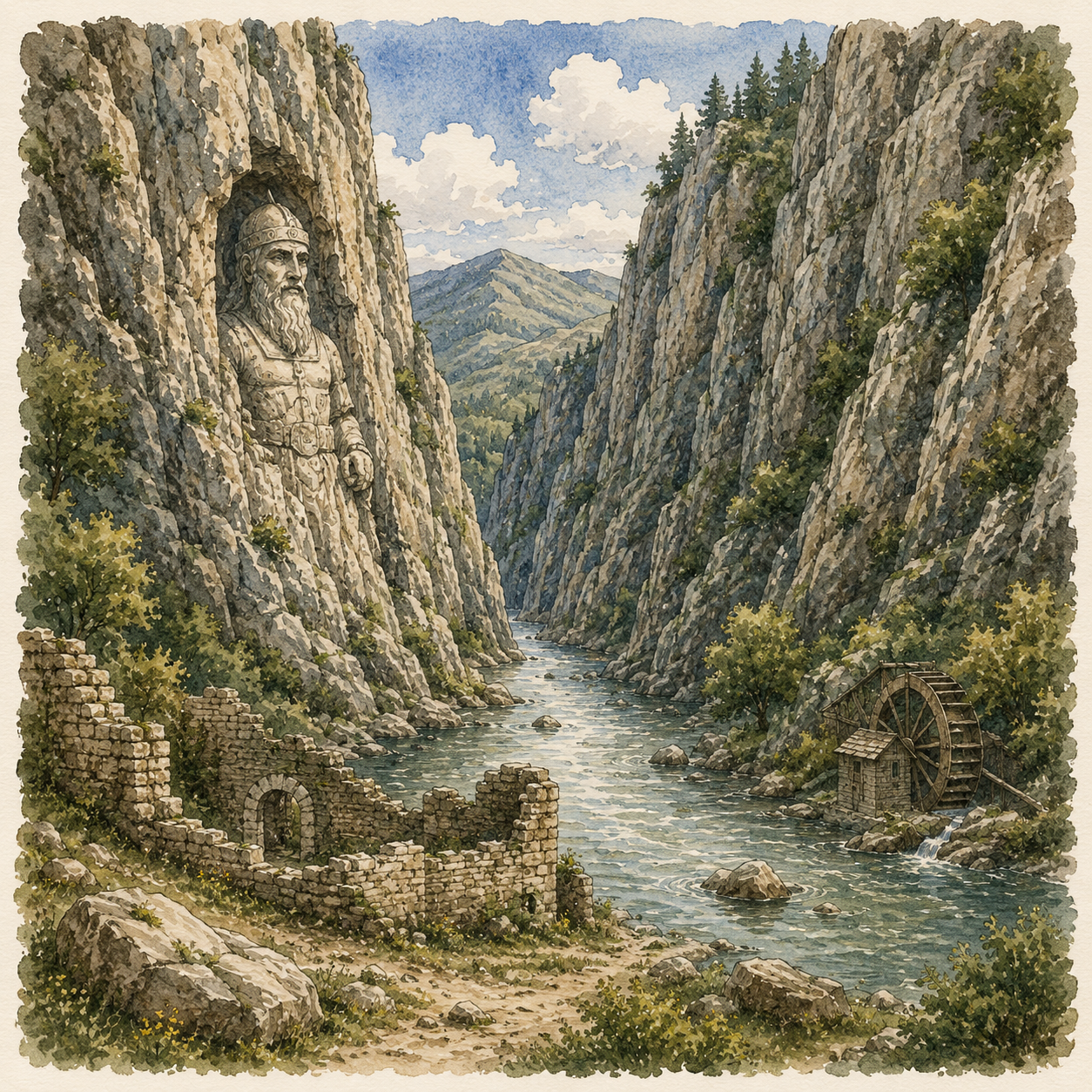
Danube Gorge – wilderness, history, and spectacular landscapes
The Danube Gorge is one of Romania's most impressive and wild landscapes. Here, the river carves its way through mountains, forming a spectacular gorge that uniquely unites nature, history, and multiculturalism. Stretching for nearly 140 kilometers, between Baziaș and Gura Văii, the Gorge represents the gate through which the Danube leaves the country, but also a space where civilizations, traditions, and unforgettable landscapes meet. It is the place where Oltenia reveals a wild, authentic, and profoundly river-bound face. Other reasons to convince you to visit it can be found in the following description:
The Danube Gorge is one of Romania's most spectacular natural regions, located on the border with Serbia and stretching between the counties of Caraș-Severin and Mehedinți. Over a distance of approximately 140 km, between Baziaș and Gura Văii, the Danube crosses the mountains, shapes limestone walls, creates narrow gorges, and forms a unique landscape in Europe. The area is part of the Iron Gates Natural Park and is renowned for its rare combination of wild nature, millennia-old history, and villages with a multicultural identity.
How to get there
-The main access is on DN57, from Drobeta-Turnu Severin towards Orșova, Eșelnița, Dubova and Svinita -By car: the road is spectacular, but in places narrow and winding -By train: the closest major train station is in Orșova -By boat: Danube tours generally depart from Orșova, Eșelnița and Dubova Tip: during the season, the road can be crowded – plan stops at viewpoints and avoid peak hours
When to go
-Spring: perfect for hiking, green landscapes and specific flowers, including the Cazane tulip -Summer: ideal for boat trips and exploring caves, but it is the busiest period -Autumn: tranquility, intense colors and excellent conditions for photography -Winter: mysterious atmosphere, with fog on the Danube and dramatic landscapes, but some accommodation units are closed
Activities in the area
-Boat trips through the Danube Cauldrons, in the area with the most spectacular narrowing of the river -Visiting Decebal's Statue, the tallest rock sculpture in Europe (55 m) -Stop at Mraconia Monastery, located on the bank of the Danube -Exploring Ponicova Caves (1600 m galleries) and Veterani, accessible by boat -Discovering the traditional villages of Dubova, Svinita, Eibenthal, known for their unique culture, gastronomy and traditions -Short trails on the peaks of the Iron Gates Natural Park -Photography at the viewpoints in Dubova, Eșelnița or at the ruins of Tricule fortress
Costs
-Boat tour: 50–80 lei / person, depending on the route -Entrance fees to attractions: most natural points are free; some caves may have symbolic fees -Accommodation: 150–300 lei/night guesthouses, higher for rooms with Danube view -Meals: 40–70 lei for a traditional meal at local terraces
Gastronomy
-The cuisine of the Danube Gorge combines Romanian, Serbian and Czech influences -Danubian fish soup with vegetables and garlic sauce -Wels catfish stew, carp brine or fried fish like on the Danube -Fresh figs and fig jam from Svinita -The aromatic wines of Mehedinți, grown on calcareous soil and in a Mediterranean climate
Many guesthouses cook "like at home", and in Czech villages such as Eibenthal you will find Central European dishes and culinary traditions.
The Danube Gorge is the place where Romania reveals one of its most impressive facets: dramatic gorges, Roman history, multicultural villages, rare biodiversity, and authentic local experiences. It perfectly combines adventure, relaxation, and cultural discovery, being an ideal destination for anyone seeking spectacular nature and well-preserved traditions – a true corner of the world where the Danube has been writing the story of the border between civilizations for thousands of years.